Project intake process: How to capture, score & start


Summary
When project requests come from all sides, teams can quickly feel overwhelmed. Without a clear system, work gets lost, priorities keep changing, and teams spend more time sorting requests than actually getting things done.
A project intake process solves this by giving your team a consistent way to collect, review, and prioritize new work. In this article, you'll find out what a project intake process is, why it's important, and how to create one that keeps your team focused on the most important tasks. We'll also share a real-world example, best practices, and answers to common questions.
Your Blueprint for AI-Powered Success
While others are still testing the waters, learn how top teams are already driving results with Asana AI Studio. Download this actionable playbook packed with real case studies and step-by-step guidance to accelerate your team's AI transformation.
What is a project intake process?
A project intake process is a set workflow that teams use to collect, review, prioritize, and act on new project requests. It replaces scattered requests and random approvals with a consistent system, so the right work happens in the right order. The process usually has three main parts:
A form to capture new project requests, including all the details teams need to get started.
A prioritization method to identify and schedule the most important work.
Pre-defined next steps to kick off work for each request.
This workflow helps teams handle work requests quickly and focus on the most important projects first.
Why is an intake process important for project management?
In project management, standardized processes help projects run smoothly. A work intake process turns the often confusing, time-consuming task of prioritizing requests into a clear workflow with defined steps. Here’s why this is important:
Faster completion times: Instead of wasting time on back-and-forth, teams can move through each step of the process quickly.
Consistent prioritization: Work is evaluated and ranked the same way every time, across your entire organization.
Less confusion: Everyone knows where to submit requests, how they'll be reviewed, and when to expect a decision.
The challenges of managing project requests
Request management is tricky. Teams ask for things at the last minute, requests come from many different places, and everyone seems to think their project is the highest priority. Here are some common challenges in request management, all of which can be solved with an effective intake process.
High request volume
A common challenge for enterprise companies, too many requests can make teams feel like they're drowning in work, leading to burnout and slow completion times. An intake process solves this with a clear prioritization method, so teams can focus on tasks with the most business impact.
Requests are scattered in different places
When requests arrive through email, chat, or meetings, teams spend extra time tracking them. Sometimes, requests get missed and are never completed. A clear intake process fixes this by collecting all requests in one place.
Requests don't include enough context
It's hard for teams to get started when they have only the bare minimum of information. This often happens when companies don't have a standardized request form to support requirements gathering and specify all the details required for each proposed project.
Ad hoc requests delay your timelines
Projects are chugging along smoothly until a last-minute, high-priority request comes in, monopolizing resources and requiring teams to push their timelines back. While ad hoc requests will always occur, an effective project intake process can prevent them by clarifying upfront how long it will take to complete a request. And if needed, it includes a predefined method for prioritizing and rescheduling project work.
How Asana uses work management for project intake
Learn how Asana's PMO leaders streamline intake and prioritize the right work for the business.
Features of an effective project intake process
Project intake processes can look different depending on your organization’s needs. Still, every process should have these three main features:
1. A project intake form
Forms are the gold standard of work intake. They give stakeholders a single centralized method to submit requests, so you can collect new work in one place rather than across scattered communication tools. Because forms standardize the information included with each request, teams get the context they need to act quickly.
What should your project intake form include?
To start, a basic project intake form should include the following sections. You can then add more questions based on what your organization needs.
Requester: Who is proposing the project?
Requesting team: What team will this work support? Is this an external or internal project?
Type of project: What kind of work is this? For example, it could be a new image, web page copy, or a video.
Request summary: In a few sentences, what do you want done?
Timing: When does this intake request need to be completed?
Priority: Is this business-critical or a nice-to-have? It's often helpful to include a numerical priority ranking, like P1, P2, P3, and so on.
Associated business goal: What company priority does this request align with, if any?
Contextual information: What screenshots, documents, or other attachments can you provide for additional context? For example, a bug request form could require a screenshot or video of the bug.
2. A prioritization method
With your form, you now have a set of clear, standardized requests. Next, you need a way to prioritize and schedule these tasks so the most important work gets done first. Here's how to establish an effective prioritization method:
Ask requesters to provide prioritization information via the form. You need data to assess the importance of each request, and your form is the best way to collect it. Instead of just asking requesters to pick a priority (and have them pick P0 every time), you can also ask for the business goal the request supports.
Create a prioritization score: Use information from the form to assign a numerical score that weights task priority, associated strategic goals, the requesting team, and so on. This helps reduce any subjectivity in the prioritization process.
Gather all requests into a single central location. To prioritize well, you need to see every request, along with its score and timing. This makes it easy to spot urgent requests and quickly assign them to your team.
Track your team's workload. Document the requests your team is currently working on, so you can clearly see what's on everyone's plate. Work management software can be handy here, especially if it lets you see and adjust team workloads in real time.
Schedule work according to the prioritization score. Now that you have the full picture of each task's priority and an understanding of your team's bandwidth, you can schedule work. When scheduling, it's helpful to use work management software that lets you visualize tasks on a timeline or calendar.
3. Plan next steps
To start work quickly, teams need a plan. Predefined next steps are key to any project intake process. They give everyone a standard way to handle any request, whether it’s a blog post or a product feature. To define next steps, consider each type of request your team handles. For each one, ask yourself the following questions:
What tasks need to happen to complete this request?
In what order should these tasks occur?
Are there any dependencies (tasks that can't be started until another is completed)?
How long will each task take?
Who is the best person to complete each task?
Then build a workback schedule for each request type, including each task (in order), the estimated time, and the assigned person. You're essentially building out a predefined project timeline for each request type. For example, here are the next steps for a marketing ebook.
Day 1: The assigned writer sets a publication date for the ebook based on how long each process step will take.
Day 2-3: The writer creates an outline.
Day 4: An editor reviews the outline and provides feedback.
Day 5-8: The writer revises the outline and writes a first draft.
Day 9: The editor reviews the first draft and provides feedback.
Day 10: The writer revises the draft.
Day 11: The editor and a PMM partner review the final draft.
Day 11: A project manager submits the final draft to the design team.
Day 11-14: The design team creates visual assets for the ebook.
Day 11: The project manager submits a request to the web team to create a gated landing page for the ebook.
Day 15: The writer and editor review the final design.
Day 16: The web team stages and publishes the landing page.
Publishing this ebook involves many steps. Some tasks must be done in order, while others can be done at the same time. By setting up the workflow in advance, your team can start right away without wasting time deciding who does what. This also helps deliver consistent, high-quality results.
How to create a project intake process
Building a good intake process from scratch or improving your current one can be tough. Here’s a step-by-step guide to help you begin.
Step | What to do |
1. Determine roles and responsibilities | Define who owns, submits, approves, and completes requests. |
2. Define how requests are approved and prioritized | Set evaluation criteria and a scoring method. |
3. Document and standardize your workflow | Outline each step from submission to delivery. |
4. Centralize your process | Bring all requests into one platform. |
5. Identify tools to make things quicker | Use templates, automations, and forms to reduce manual work. |
6. Communicate the process | Train your team and share documentation. |
1. Determine roles and responsibilities
Start by clearly defining who is involved in the process and what each person is responsible for. Setting these roles early prevents confusion and makes sure everyone is accountable. Key roles to define include:
Process owner: The person who oversees the entire intake workflow.
Requesters: The individuals or teams responsible for submitting project requests.
Decision-makers: The stakeholders who approve or decline requests.
Project owners: The team members tasked with reviewing and prioritizing work to ensure it aligns with strategic priorities.
2. Define how requests are approved and prioritized
Establish an approval process and decision-making process for how key stakeholders should evaluate incoming project requests. Common criteria to consider include:
Project size and amount of work required
Expected impact on business goals
Available resources and team capacity
Strategic importance and alignment with organizational priorities
Use these criteria to develop a prioritization method that ranks requests, so resources are allocated to the initiatives that offer the greatest value.
3. Document and standardize your workflow
Create a standardized workflow that outlines each step of the intake process, from submission to final delivery. This documentation should include roles and responsibilities, criteria for evaluating requests, your submission form, and each step required to prioritize and complete a project. A standard intake process ensures consistency, reduces errors, and streamlines the process.
4. Centralize your process
Next, consolidate your entire intake process into a single central system or platform. For example, you can use a work management tool to collect, prioritize, and track requests in one place. Centralization is especially important in larger companies to manage requests, track progress, and keep everyone informed.
5. Identify tools to make things quicker
Leverage technology to automate and expedite parts of the intake process. This can include using templates for project requests, automations to route requests to the appropriate approvers, and forms to standardize submissions. These tools reduce manual work, increase efficiency, and capture all necessary information from the start.
6. Communicate the process
Finally, make sure everyone understands how the intake process works, their roles, and how to use any related tools or platforms. This could include training, written guides, or demo videos. Clear communication helps avoid confusion and keeps the process running.
How Asana uses work management for project intake
Learn how Asana's PMO leaders streamline intake and prioritize the right work for the business.
Project intake process example
Here’s an example to show how this works. Imagine you’re on an agile team that handles new feature requests. Your project intake process might look like this:
A project initiator completes a project intake form, detailing what the feature should include, why it needs to be created, and when it needs to be completed.
A project management office (PMO) reviews the project request form and performs an initial assessment to determine the desirability, viability, and feasibility of creating the new feature.
Based on their assessment, the PMO approves or denies the request and assigns a prioritization score.
The PMO adds the request to the engineering team's product backlog and schedules it based on the prioritization score.
Schedule a kickoff meeting.
A project manager uses information from the project intake form and kickoff meeting to complete a proposed project. They base this project proposal on a set of predefined basic steps for every new feature launch.
A senior stakeholder approves the proposal or sends it back for more work.
The project manager creates a more detailed project plan from the proposal.
The project manager allocates resources, assigns tasks, and sets a launch date.
The project team starts work.
Project intake best practices
Once your intake process is in place, these best practices will help you keep it effective and easy to scale as your team grows.
Make sure someone owns the process. Every intake process needs a dedicated owner, like a project manager, PMO lead, or operations manager. This person keeps the process running, fixes bottlenecks, and ensures requests move forward on time.
Make sure everyone follows the process. An intake process only works if everyone uses it. Set a rule that all requests must go through the formal process, regardless of size or urgency.
Use a dashboard to keep everyone informed. Create a central dashboard that lets stakeholders quickly see the status of all requests. This reduces status-check messages and lets everyone know what’s been submitted, what’s in progress, and what’s coming up.
Test your process before rolling it out to everyone. Start with a pilot in one team or department. Collect feedback, find any issues, and improve the workflow before using it across the whole organization.
Give feedback on declined requests. When you deny or delay a request, explain why. A brief explanation helps people understand your decisions and reduces the need for repeated submissions.
Take your intake process to the next level
With these tips, you can turn your project intake process into a reliable, repeatable workflow. To streamline your processes even more, learn how experts use Asana to build smarter, scalable enterprise processes. Ready to see the difference for yourself? Get started and bring clarity to your team's intake workflow today.
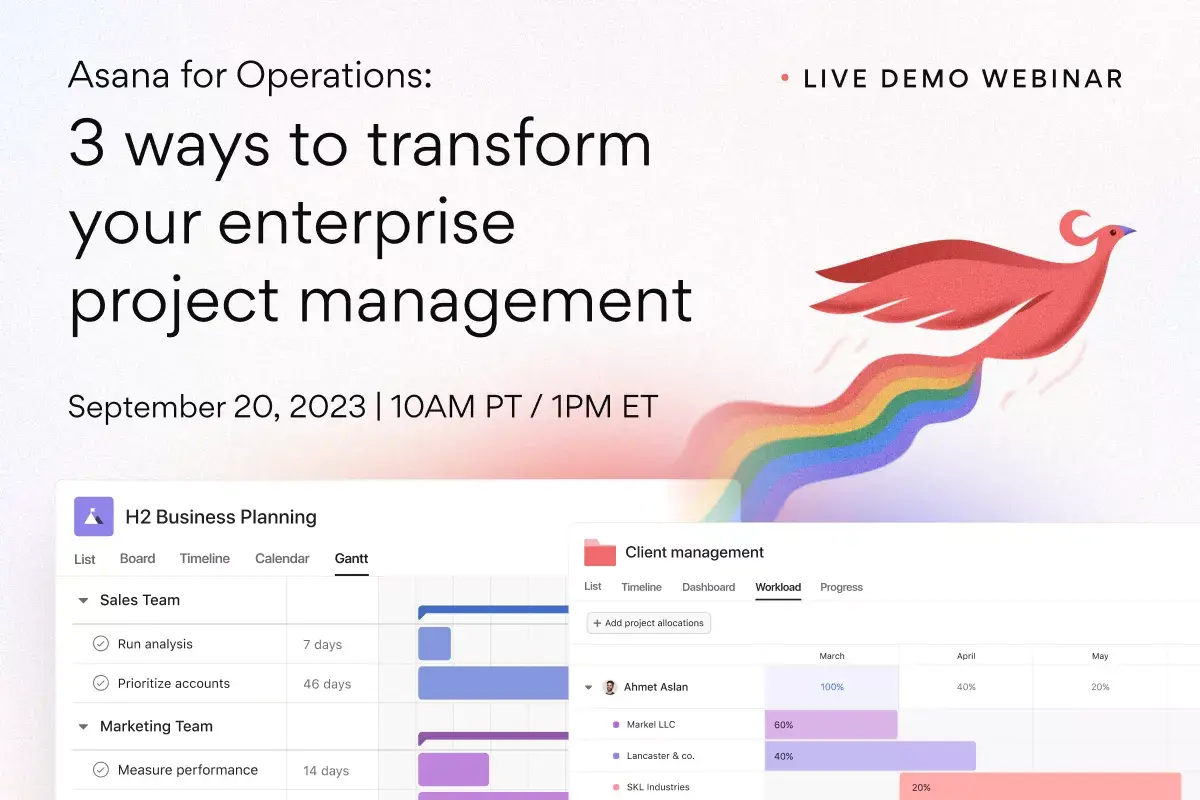
3 ways to transform your enterprise project management
Watch a live demo and Q&A session to help you streamline goal-setting, accelerate annual planning, and automate how teams intake strategic work.