17 management techniques for engaged, productive teams


Summary
Management isn't just about giving orders. You need to handle people, projects, and time. Each requires a different approach, but together, they shape how successful your work will be.
Our research shows that 44% of employees would feel more motivated if their work were engaging and enjoyable. But how can you create an environment for your team that allows them to feel this way?
We've put together 17 management techniques to help you connect with your team, build a productive, enjoyable workplace, and achieve your business goals.
Transform Your Marketing Operations
See how leading marketing teams use Asana to streamline planning, automate processes, and accelerate campaign delivery. Watch our demo to learn proven strategies for standardizing workflows and scaling your marketing impact across teams and agencies.
What are management techniques?
Management techniques are practical ways for leaders to guide their teams, organize work, and reach business goals. Using these methods helps you create an environment where your team can do their best.
Effective management techniques fall into three categories:
People management: How you lead, motivate, and develop your team members
Project management: How you plan, organize, and execute work
Time management: How you and your team prioritize tasks and use time wisely
Great managers use a mix of all three types of techniques to keep their teams engaged and meet business goals.
1. Communicate effectively
Communication is the glue that holds everything together. You need to communicate effectively to get projects done on time, keep your team members motivated, and ensure stakeholders are happy.
Create a communication plan for your team that defines:
Channel guidelines: Which tools to use for different types of communication (e.g., Slack for quick check-ins, email for external communication)
Communication modes: When to communicate asynchronously versus in person
Roles and responsibilities: Who holds what kind of project roles
Cadence: How frequently important details will be shared
2. Create an inclusive environment
When you bring people from different backgrounds together, it's important that everyone feels safe and welcome. Diversity can help your team grow, but without inclusion, misunderstandings can happen.
Check your unconscious bias to examine assumptions, beliefs, or attitudes you may have internalized. Being aware of your bias is the first step toward combating it and opening your mind to a more inclusive and diverse workplace.
Understanding how cultural, gender, and other forms of diversity affect your team makes you a stronger leader. Practice emotional and cultural intelligence to create a strong organizational culture for your team.
3. Hire the best team
This should go without saying, but the better your team, the more rewarding it will be to manage them. Hire teammates who have complementary skills and diverse backgrounds to promote creativity and innovation and, in turn, drive progress.
A diverse hiring approach helps you attract more talent. Try using different hiring channels and ask employees from all levels and departments for recommendations.
Read: Team structure: 10 effective ways to organize your team4. Choose the right leadership style
Your personality and workplace experience will inevitably influence your leadership style, but so will your team! A situational leadership style allows you to tailor the way you lead and manage your team to their individual needs, traits, and situations. Depending on the amount of support and direction your team needs, you can apply any of the four types of situational leadership: delegating, supporting, coaching, or directing.
If situational leadership doesn't feel right for you, there are many other styles you can use that fit your personality.
Read: Qualities of a leader: 17 traits of effective leadershipAt Asana, we lead by example. This consistent and approachable leadership style can increase team engagement and trust. At the same time, leading by example inspires those around you and builds a culture of accountability.

As a leader, I know it’s my responsibility to set the tone for our company culture.”
In the end, what matters most is picking a leadership style that fits you and helps your team reach your organization's goals.
A leader's guide to change management
Learn how to be the leader your team needs during times of change. Get tips on when to set new business objectives, how to communicate transparently, and how to keep employees engaged.

5. Delegate effectively
You can't do it all by yourself; that's the benefit of managing a team of talented, hard-working, and determined people. One of the most effective management techniques is delegating work.
Effective delegation helps you maximize your team's productivity while preventing burnout. To delegate effectively, consider:
Team member skills: Match tasks to each person's strengths
Growth opportunities: Assign projects that help team members develop
Workload balance: Ensure no one is overloaded while others have capacity
First-time managers in particular may struggle with this technique since it's difficult to distance themselves from the work itself while still maintaining the feeling of contributing to the project. Motivate yourself to delegate by considering how new projects will positively affect your team members.
If delegating feels unnatural, that's okay. Remember, your main job is to help your team succeed by giving them the right resources and environment—not by doing all the work yourself.

6. Recognize hard work, talent, and engagement
Recognizing and rewarding your team's efforts keeps them engaged. Performance reviews help, but try to show appreciation in other ways too to grow as a manager.
Gratitude makes your team feel valued. Plus, receiving positive feedback when they're doing their job well has been shown to reduce the negative effects that stress can have on their performance.
Whenever you appreciate your team or a team member's specific contribution, tell them. Hana Ayoub, a New York-based executive coach, told us that team members who internalize a strength that's been pointed out to them by their managers can leverage these natural talents in the future.
It's a win-win for everyone. Regular feedback (good or bad) allows your teammates to adapt and improve their work more efficiently than if they had to wait for their next annual review.
Read: Don’t like giving feedback? These 20 tips are for you7. Put your team first
A management technique that can easily be overlooked is to genuinely care about your team beyond their contributions at work. A team that feels like they're more than just numbers to you will typically be more engaged and collaborative at work.
Show your team you care about them as human beings by actively listening when they talk to you:
Tune into their words and put your own biases aside
Avoid jumping to conclusions or overanalyzing
Ask open-ended questions to show you're paying attention
This type of listening skill can be incredibly helpful when resolving conflicts, facilitating meetings, or problem-solving. Plus, giving your teammates the mental space to talk about what's on their minds can spark new, easy-to-come-by solutions.
When your teammate brings up the problem they need to solve, reflect back on what they’re saying (‘What I hear you saying is…’). Sometimes just hearing a problem relayed back inspires someone to realize they already know the answer.”
Hone your emotional intelligence to get better at recognizing, regulating, and understanding your own emotions and those of your team members. This will help you communicate more effectively, solve conflicts, and build team synergy.
8. Provide professional development opportunities
Besides providing your team with regular feedback, offering them professional development opportunities is another management technique that will help your team grow under your leadership.
Find out what motivates your teammates, and actively listen when they talk to you about their long-term goals so you can support them on their path to achieving these objectives.
If your teammates are stuck or if they're feeling overwhelmed, assist them in defining their professional goals. Sometimes, all they need is an outside opinion and a little nudge to set goals that will get them back on track.
9. Be open to new ideas
If you've hired the best people to be on your team, you should trust them to have some of the best ideas. As their manager, you need to make sure that you're open to new ideas, whether they're ideas on how to drive your project forward, improve team collaboration, or fix a flaw in your business plan.
No great concept will come to fruition within a silo.”
In addition to being open to their ideas, you should give your teammates opportunities to share them. You can hold regular brainstorm sessions, set up a shared brain dump task in your work management system, and encourage honest feedback during coffee meetings. All of these are excellent opportunities to inspire creativity and an ongoing feedback loop that makes your team happier.
10. Be clear and consistent
We've already talked about how important consistency is when leading by example, but it's such a key part of being a successful manager that it's worth exploring further.
Your team needs clear, consistent management so they can focus on the tasks at hand rather than spend time clarifying whether their approach is correct. When you achieve a level of consistency that your team can rely on, you provide them with clarity of purpose, plan, and responsibility.
Read: 9 strategies for successfully managing multiple projectsApply clarity and consistency to:
How you schedule projects and meetings
Your approach to leading calls
How you communicate praise and constructive feedback
How you set expectations
How tasks are delegated
If you’re leading a team that is part of a larger organization, one of the most important things you can do is to help everyone on your team understand how the larger organization is impacting the world, how your team is critical to the success of the organization, and how their individual work is important to the success of the team.”
Consistency doesn't block innovation—done right, it encourages it. When your processes are clear, your team spends less time on busywork and more time sharing creative ideas.
11. Manage time wisely
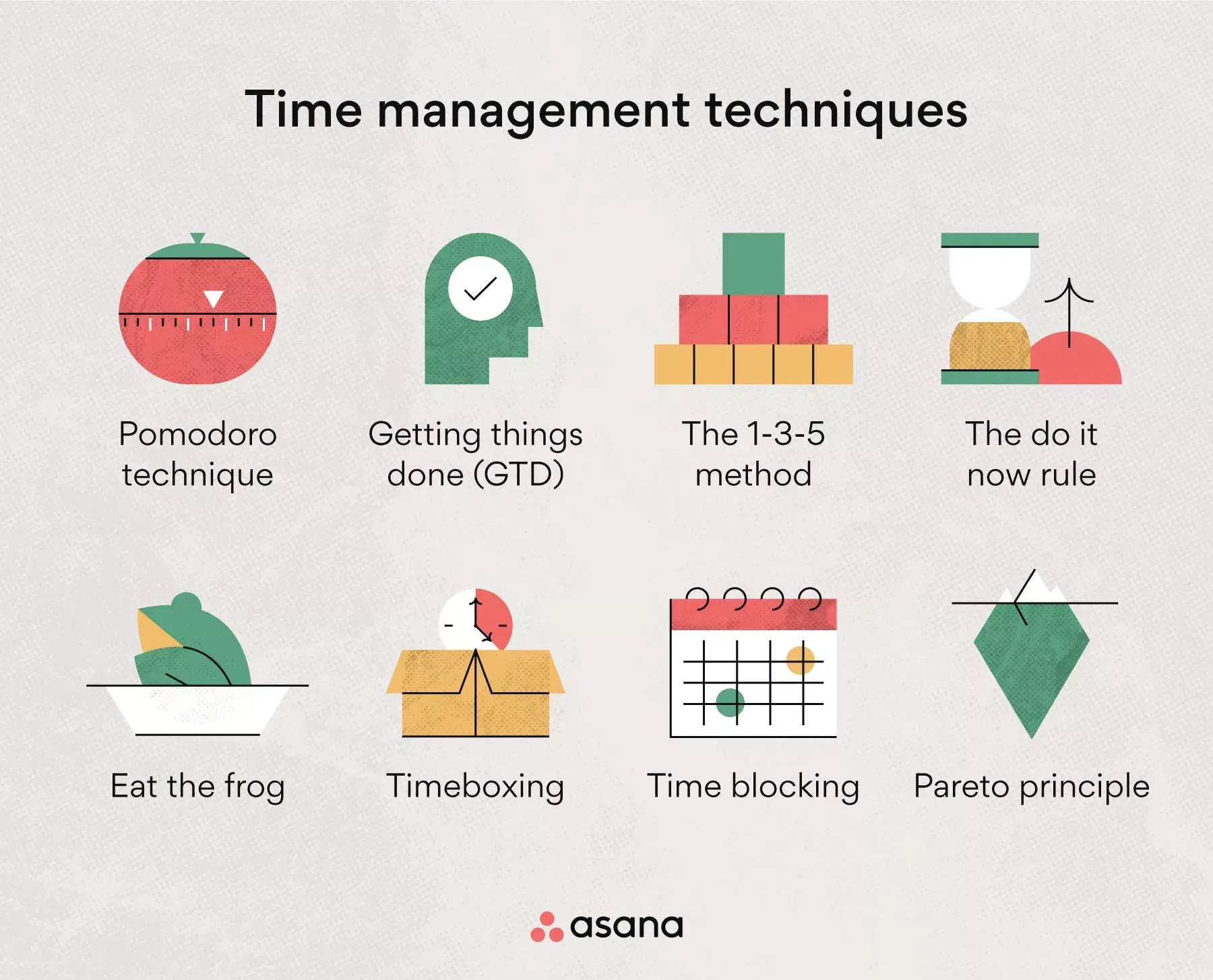
Stellar time management is a skill that will set you apart from other managers. Managing your own time and that of your teammates well will help you stay on top of projects without making you feel overworked. There are endless ways to manage your time, and time management templates can help you put these techniques into practice:
The Pomodoro Technique
The Pomodoro Technique is a way to break your workday into productive sessions and breaks. The idea is to work for 25 minutes, then take a 5-minute break, and repeat the cycle 4 times. After the fourth session, you can take a longer break, usually 15–30 minutes. While it may seem that this time management technique interrupts your flow, it actually reduces mental fatigue and helps limit distractions during focus sessions.
Example: This is how you could break up your first four Pomodoro sessions of the day:
25 minutes of answering emails, five minutes of coffee break
25 minutes of QAing a report, five minutes on social media
25 minutes to finish QAing the report, five minutes to do a few stretches
25 minutes of scheduling tasks
30 minutes of taking your dog for a walk
The GTD technique
GTD stands for Getting Things Done, a technique that operates with the belief that the more information you're trying to keep track of, the less likely you are to be productive and focus on your tasks. This technique can be extremely useful if you struggle with procrastination.
GDT works in five steps:
Capture the work you have to do
Clarify details
Organize your tasks
Reflect on your priorities
Get the bulk of your work done
The 1-3-5 rule
The 1-3-5 method allows you to prioritize your most important work, much like a priority matrix, while also getting some smaller things done. When you're compiling your daily to-do list, write down nine tasks that you'd like to accomplish every day, but separate them into five small tasks, three medium tasks, and one big task. Complete the big tasks first, then work on your smaller tasks.
Example: Here are a few examples of small, medium, and big tasks.
Small tasks: Send quick emails, schedule meetings, order office supplies, etc.
Medium tasks: Update documentation, QA blog post, send procurement request, etc.
Big tasks: Launch website, lead client call, brainstorm, etc.
The do it now
This method is simple: if a task takes just a few minutes, do it right away. Don't let this method distract you from urgent work. If doing a task takes as long as writing it down or setting a reminder, it's best to just do it now.
Example: You're in the middle of writing a report and have to check your email to grab some data when you see that your supervisor sent you a request to share access to a document. Rather than writing this task down and clouding your brain with yet another small task that needs to be done later on, just click those few buttons and then get back to your report.
Eat the frog
The eat the frog time management technique is built on the idea of getting the worst part of your day (e.g., eating a frog) done first. Planning your day around this strategy will allow you to tackle the biggest or most important tasks first thing in the morning and make the rest of your day more enjoyable.
Example: Your schedule for the day looks quite fun: you have a team lunch planned, a blog post in the works on a topic you proposed, and you get to contribute to an asynchronous brainstorming session. But you also have to update your client tracker, which is your least favorite task of the month. That's your frog. Swallow it early in the day so you can enjoy the rest of it!
Timeboxing
Timeboxing is a goal-oriented time management technique where each task has an associated timebox, or the amount of time in which that task should be completed.
Example: If you have a big task on your plate, like writing a performance review, you can schedule two 1-hour timeboxes on your calendar to help you finish it.
Time blocking
Time blocking is very similar to timeboxing, but rather than allocating timeboxes for individual tasks, you block dedicated periods on your calendar for groups of similar tasks. This can help increase focus time and unlock deep work.
Example: Block half an hour in your calendar every Monday, Wednesday, and Friday between 9:30 and 10:00 a.m. to bring your email inbox down to zero.
Read: Why Inbox Zero isn’t what you think it isThe Pareto principle
The Pareto principle states that 80% of outcomes come from 20% of causes. If you want to apply this principle to your time management, you can use the 80/20 rule. Write down your to-do list for the day and find out which of the tasks will have the highest effect on your team, project, or business that day.
Focus on the top 20% of tasks that will give you 80% of the results before moving on to other work.
Example: On your plate for the day are two annual reviews due next week, a few sales emails you've been avoiding, and four sales and revenue reports you need to QA. While writing the annual reviews or sending those sales pitches are important tasks, QAing the reports first will make the biggest difference for your team because it allows them to continue their work.
12. Value your team's time
Time management helps you do your best work, but it's also important to respect and value your team's time.
Show your team you value their time by keeping your communication focused:
Be concise: Keep emails, messages, and calls to the point
Be specific: Clearly express what you need, when you need it, and how you want it done
Clear communication lets your team focus on their work instead of guessing what's expected.
Another way to show your team that you value their time is to implement a no-meeting day every week. At Asana, we've found that no meeting Wednesdays enable our teammates to get really productive, because there are no interruptions.
Read: 6 tips to harness the power of flow state at work13. Leverage technology and work management tools
Whether your team works together in person or is spread out around the world, having one place for all your information is essential.
Work management software can help you connect with your teammates, set goals, schedule tasks, and track progress. Besides saving everyone time spent on busywork, streamlining all of your projects and communication in one tool will make it easier for everyone to stay on top of their work.
A work management tool is the best way to centralize your team's information. Clearly see who's doing what by when, why it matters, and which goals that work supports. These tools, like Asana, include ways for your team to:
Visualize your team's work in a Kanban board, Gantt chart, or team calendar.
Track progress towards personal, team, and company goals with SMART goals, OKRs, and goal tracking.
Implement project management methodologies like Agile or Scrum.
Share progress updates asynchronously with project status updates that directly tie to the work that's been completed.
Integrate your favorite business tools to reduce app switching and manual work.
A leader's guide to change management
Learn how to be the leader your team needs during times of change. Get tips on when to set new business objectives, how to communicate transparently, and how to keep employees engaged.
14. Plan ahead and anticipate risks
The project management tools and methodologies listed above help with troubleshooting. However, you also need to plan ahead during project initiation to keep projects running smoothly.
Take a two-step approach:
Before the project: Use resource allocation to identify and assign available resources, maximizing your team's effect
During the project: Apply risk management processes to track and anticipate complications before they arise

15. Promote positivity and work-life balance
Work and play don't go together? We'd like to disagree. A team that plays well together will also collaborate better and, in turn, get its best work done. Make time for team-building exercises to give your team the chance to connect on a human level.
Don't limit fun to just team-building events. Add small moments of fun, like starting meetings with an icebreaker, having regular happy hours, or celebrating milestones with a team dinner.
Connecting with your team on a more personal level will create stronger bonds, making work more enjoyable and fulfilling for everyone involved. Besides, teams that have fun at work tend to feel like they have a healthier work-life balance.
We usually don’t know someone’s burned out until they actually burn out. But an intuitive and involved manager should be able to catch the early signs. Encourage all managers to maintain regular 1-1’s with reports and don’t just talk about business. Use the time to get a feel for how the individual is doing as a human.”
16. Be transparent
Being transparent as a manager takes some skill. Share important information with your team, but be careful not to share too much and cause stress or distractions.
If you're not sure whether to share certain information with your team, ask your supervisor. They can tell you what to share and help you find the best way to communicate it without causing stress.
A big part of being transparent and honest with your team is ensuring they know how their individual work contributes to the company's goals and success. Make sure your team has a clear way to connect their daily work and project-level initiatives with your company's goals so they can begin with the end in mind and see how their everyday work comes together in the grand scheme of things.
17. Make confident decisions
Good decision-making is key to being an effective manager. Your team relies on you to make timely, informed choices that keep projects on track and support your organization's goals.
To strengthen your decision-making:
Gather input: Collect relevant information from team members and stakeholders
Weigh implications: Consider both short-term needs and long-term effect
Communicate clearly: Once decided, share your decision and rationale
Own the outcome: Take responsibility whether it succeeds or requires adjustment
Remember that indecision can be more costly than an imperfect choice. When you make decisions confidently and learn from the results, you build trust and create momentum.
Connect your team with one tool
The 17 management techniques shared above can help you be a great leader, but don't pressure yourself to do every one of them all the time. It's OK if you're naturally talented at some management techniques and still developing others; you're only human! To help alleviate some of the stress you may be experiencing, streamline your projects and communication with a reliable, flexible work management tool.
Asana's work management software allows you to minimize app switching and empowers you and your team to focus on planning. Plus, coordinating your projects can drive your business forward. Get started today and see how these management techniques come to life when your team has the right tools to collaborate effectively.
A leader's guide to change management
Learn how to be the leader your team needs during times of change. Get tips on when to set new business objectives, how to communicate transparently, and how to keep employees engaged.